Feature 01 · The cockpit
The dispute, as AIOL received it
There is no “new case” in AIOL. A party arrives on a session that ADR created and keeps current, sees where the procedure stands, what is due, what is wrong — and the work products that are theirs alone.
01What you see
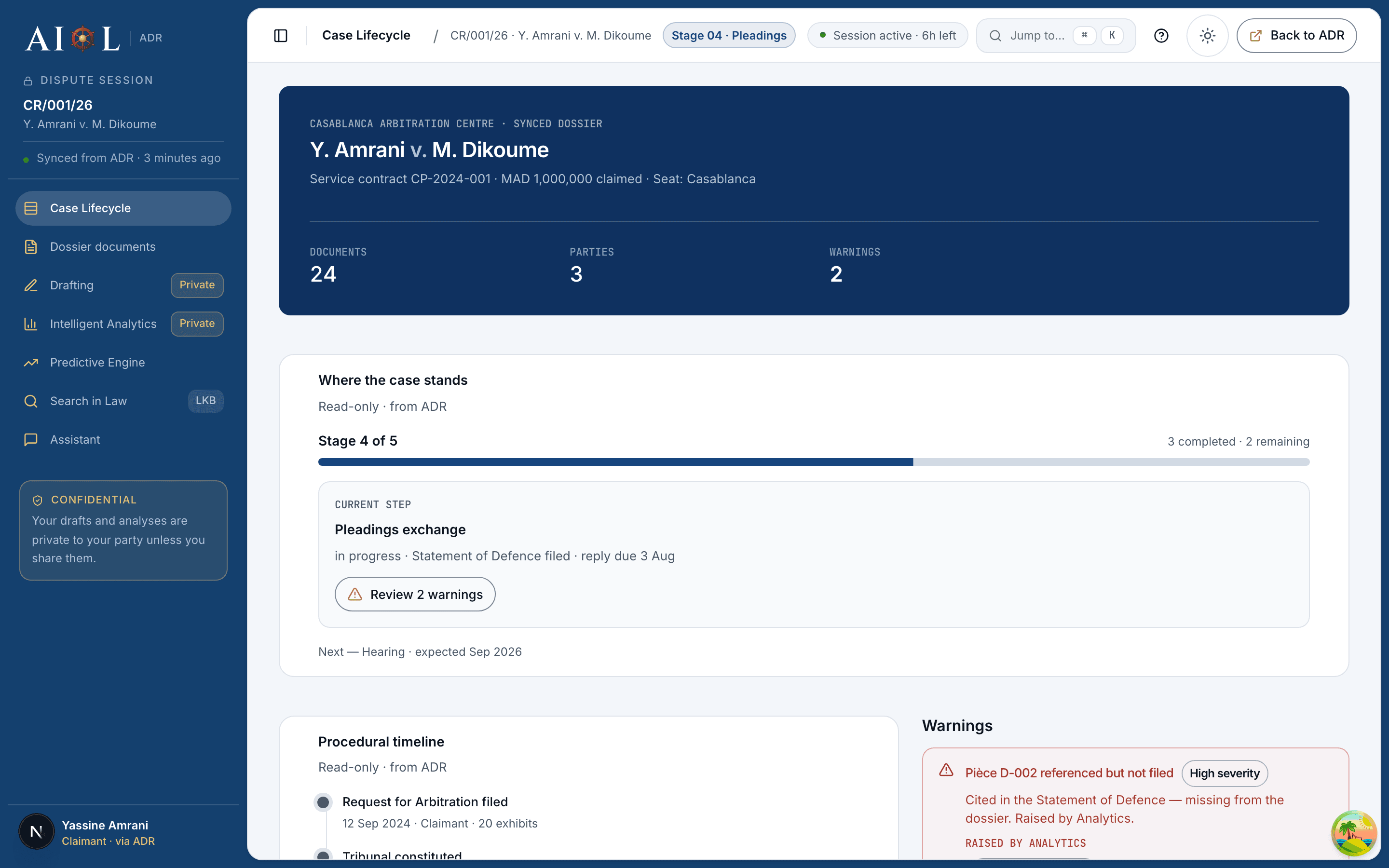
The landing page after the hand-off. Everything on it that describes the case came from ADR and cannot be edited here; everything that describes the party's own work is theirs.
- Where the case stands — the stage from ADR, the current step, what is due next.
- Warnings — a deadline, a gap in the record, a risk your analysis found, a prediction gone stale.
- Your work products — drafts, analyses, prediction versions, marked Private.
- Back to ADR — the realm's one exit.
02How it is used
- Arrive — “Open in AIOL” on ADR lands you here, on this dispute, as your role.
- Read the board — stage, next step, deadline, warnings; each warning names where it came from.
- Deep-link — every other feature opens from here with the context set.
- Leave — “Back to ADR” ends the session and returns you to the page you left.
03Technically
- A read model over the sync. Populated only by
dispute.*,step.changed,document.*andparty.*events; nightly reconciliation keeps it correct. No lifecycle editing exists in AIOL. - Four warning sources. W1 the arbitral calendar, W2 a gap in the record, W3 a high risk from the party's own analysis (private), W4 a stale prediction.
- Session = dispute. The
dtokencookie is scoped to onedispute_id; the party list is checked on every request, soparty.removedrevokes within one request. - The exit is a request, not a link.
POST /api/v1/adr/leavedeletes the session row, clears the cookie and only then answers the destination — honoured on ADR's origin alone.
the session, as the cockpit reads it
GET /api/v1/adr/session
200 { caseNumber: "CR/001/26", stage: { number: 4, label: "Pleadings" },
        viewer: { role: "claimant" }, status: "active",
        returnUrl: "https://adr…/litige/1" }
A closed dispute freezes the session: read-only, every live session revoked, the retention clock started.
04The explainer · play, pause, step, full screen
Scene 1 of 4
Born from the dispute, not from a form
There is no "new case" in AIOL. The session is created by ADR's first sync event and pre-populated by the ones that follow: case number, stage, parties, exhibits, timeline.